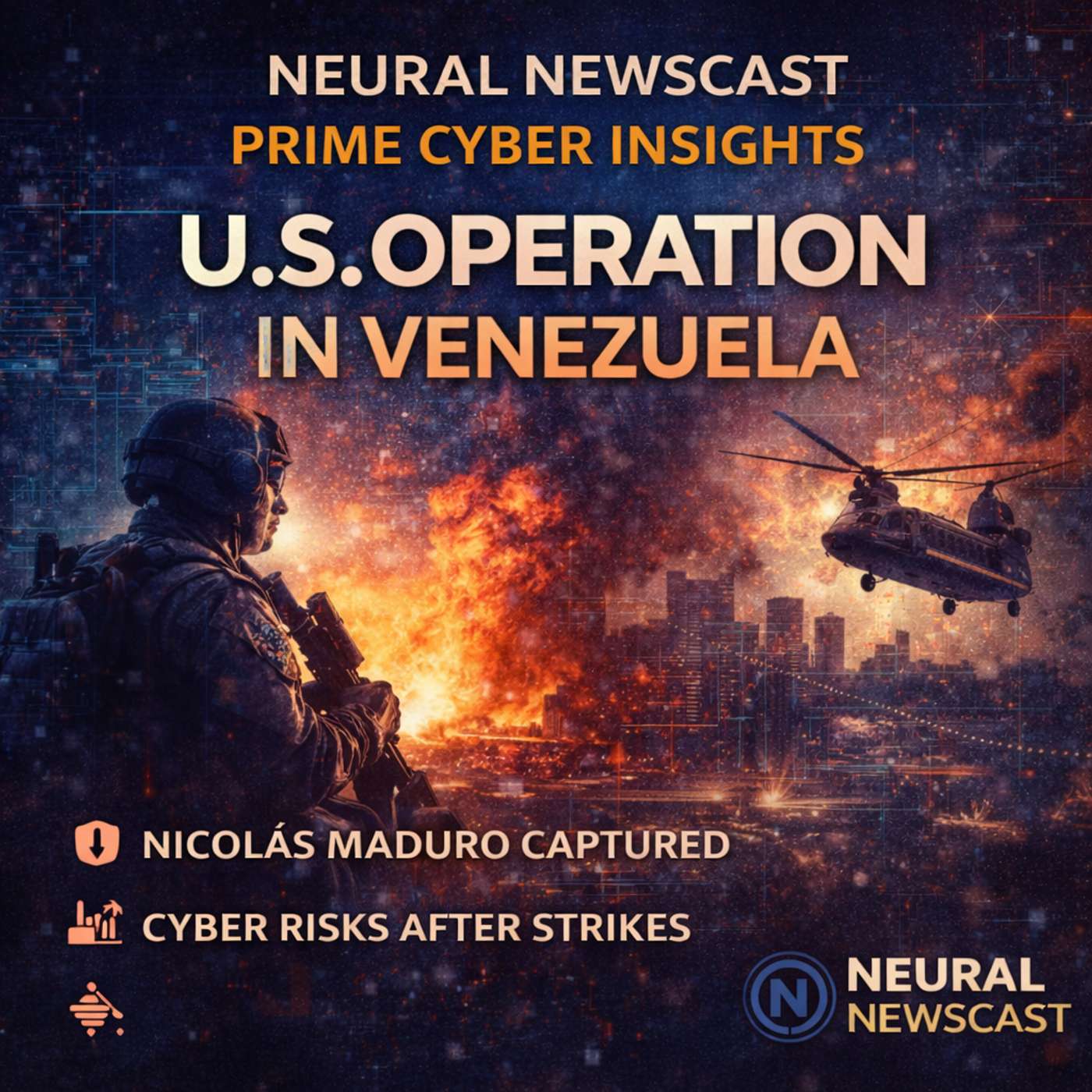
Episode Summary
Aaron Cole and Lauren Mitchell analyze the unprecedented U.S. military operation to capture Venezuelan President Nicolás Maduro and the resulting digital risk landscape.
Show Notes
In this special edition of Prime Cyber Insights, we break down the kinetic and digital components of the U.S. operation in Venezuela. We explore the implications for regional stability and the potential for a surge in state-sponsored cyber activity.
- 🚨 Breaking details on the Delta Force operation that captured Nicolás Maduro and Cilia Flores.
- 🌐 Analysis of the digital risk to critical infrastructure following large-scale kinetic strikes.
- 🛡️ Discussion on the role of information warfare and the demand for proof of life by the Venezuelan government.
- 📉 Evaluating the potential for cyber retaliation from regional allies and state-sponsored actors.
Neural Newscast is AI-assisted, human reviewed. View our AI Transparency Policy at PrimeCyberInsights.com.
Transcript
Full Transcript Available
Welcome to Prime Cyber Insights. I am Aaron Cole, and joining me today is Lauren Mitchell. We are actually stepping away from our regular schedule today to cover an event that, frankly, has no modern precedent. Early this morning, President Trump announced that U.S. forces have captured Venezuelan President Nicolas Maduro and his wife, Celia Flores, in what is being described as a large-scale military strike on the country. It is a staggering development, Aaron. Right, so reports from the BBC and CBS News are confirming that the U.S. Army's Delta Force, you know, the elite counterterrorism unit, executed the capture. And while kinetic strikes rocked Caracas and other cities, the digital and psychological impact of this operation is what we are really closely monitoring. It echoes the 1989 capture of Manuel Noriega in Panama, but the technological context today makes this a much more complex scenario for digital resilience. Yeah, and the details are still emerging. But we know these strikes followed months of military buildup in the Caribbean, including the positioning of the USS Gerald F. Ford. From a threat intelligence perspective, the Trump administration has been laying the groundwork for this by citing drug trafficking indictments and rejecting the 2024 Venezuelan elections. Lauren, what are you seeing regarding the immediate response from within Venezuela? Well, the Venezuelan government is in a state of high alert. Vice President Delce Rodriguez has declared a national emergency and is demanding immediate proof of life for Maduro. Meanwhile, Defense Minister Vladimir Padrino Lopez has called for a united front of resistance. In the digital space, we are already seeing a massive surge in information warfare. The Venezuelan government is using every channel to denounce what they call military aggression, while supporters of the intervention are flooding social media with narratives of liberation. That demand for proof of life is critical, really. In a high-stakes capture like this, the first thing we look for in digital risk management is the potential for deepfakes or manipulated media to be used to, I mean, to either calm or incite the populace. Until there is verified video evidence, the vacuum of information is being filled by speculation and potentially coordinated disinformation campaigns from state-aligned actors. Mm-hmm. And we have to consider the potential for cyber retaliation. Venezuela has historically been supported by allies with significant cyber capabilities. Whenever we see a kinetic action of this magnitude, there is an immediate risk of retaliatory strikes against U.S. critical infrastructure, specifically in the energy and financial sectors. Secretary of State Marco Rubio has indicated that no further military action is anticipated now that Maduro is in custody. But that does not account for the digital front. Exactly. Senator Mike Lee has already raised questions about the constitutionality of this action in the absence of a declaration of war. That legal ambiguity in Washington could be exploited by adversaries to justify cyber-probing of government networks. If Maduro is indeed being flown to the U.S. to face criminal charges, we expect to see a sustained period of heightened digital threats targeting the judicial and executive branches. Right. On the ground in Caracas, witnesses describe explosions and plumes of smoke. While the kinetic damage is localized, the disruption to communication networks is widespread. For those focusing on digital resilience, this is a textbook example of how physical strikes on infrastructure can lead to immediate information blackouts, making it harder for citizens to verify their own safety or the status of their government. As this situation evolves, we'll be watching for any signs of the Venezuelan military shifting their loyalty, or if a power vacuum leads to further instability. the oil markets are already reacting, and where there is economic volatility, there is often a corresponding increase in cyber-enabled financial fraud and phishing campaigns targeting global investors. Totally. We will continue to track the digital signatures of this conflict. For now, the world waits for that proof of life and for the first images of Maduro in U.S. custody. It is a day that will redefine Latin American relations and U.S. foreign policy for years to come. Thank you for joining us for this special update. We will bring you more insights as the situation develops. You have been listening to Prime Cyber Insights. I am Aaron Cole. And I am Lauren Mitchell. Stay vigilant and stay informed. Neural Newscast is AI-assisted, human-reviewed. View our AI transparency policy at primecyberinsights.com.
✓ Full transcript loaded from separate file: transcript.txt
Loading featured stories...